

An auditing firm Singapore companies hire performs an independent audit of your financial statements and expresses an opinion under the Singapore Standards on Auditing. The work runs across roughly six to eight weeks: engagement and scoping, planning and risk assessment, fieldwork, review, and sign-off. The biggest driver of whether you hit your deadline is not the firm. It is how fast your finance team answers questions during fieldwork.
Most companies hiring an auditor for the first time have no idea what the auditor will be doing for the next six weeks. Here is the week-by-week version, the prep list that keeps your audit on schedule, and the four moments where audits actually slip.
What does an auditing firm do, and what does it not do?
An external auditing firm checks whether your financial statements give a true and fair view, then issues an independent opinion for shareholders and ACRA.
It does not prepare your accounts for you, because that would compromise independence. It does not run your internal controls. And it does not give you a guarantee against all fraud; an audit is designed to obtain reasonable assurance that the statements are free from material misstatement, not to catch every irregularity.
What it gives you is independent assurance over the numbers you publish. If you want assurance over how the business runs internally, that is internal audit, a separate service explained in internal audit vs external audit.
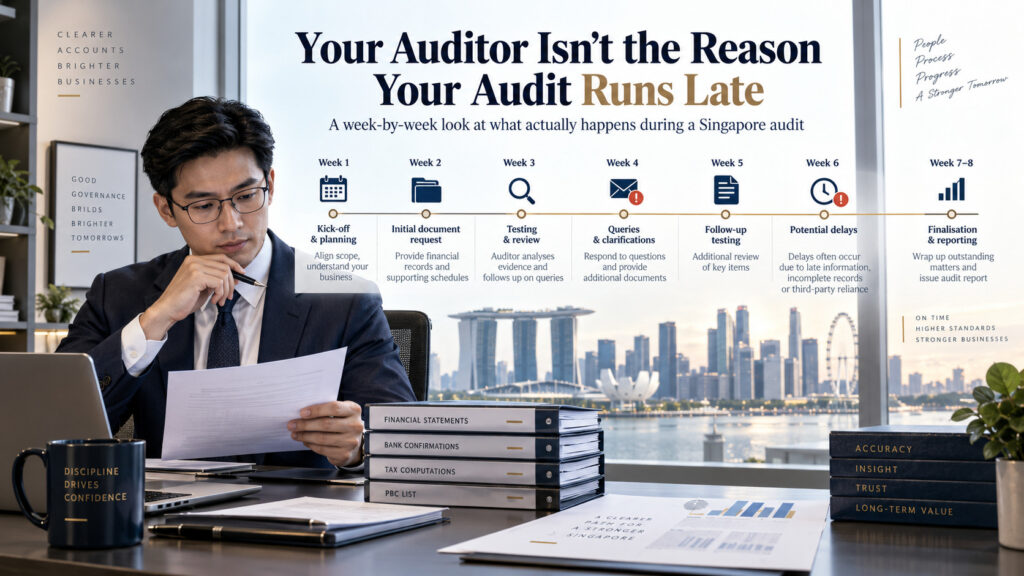
How does an audit firm work? The audit process in Singapore, week by week
Timings vary with company size and the state of your records, but a typical SME statutory audit follows this shape.
| Stage | Typical timing | What happens | What you do |
| Engagement and scoping | Week 0 | Engagement letter defines scope and fee | Settle scope before work starts |
| Planning and risk assessment | Weeks 1 to 2 | Auditor learns the business, identifies risk areas, sends the request list | Return the request list fast |
| Fieldwork | Weeks 3 to 5 | Testing of transactions and balances; follow-up queries | Answer queries within a day or two |
| Review and management letter | Weeks 6 to 7 | Independent file review; control observations raised | Review the draft statements |
| Sign-off and AGM | Week 8 | Partner signs the opinion | Hold the AGM, file the annual return |
A clear scope in week 0 prevents fee creep later, so settle it before work starts. AG works to a published 30-day completion KPI for qualifying engagements, which compresses this timeline when your records are ready.
The four moments your response speed sets the deadline
Audits rarely slip because the auditor is slow. They slip because a query sits unanswered. Four points matter most:
- Returning the initial request list during planning
- Answering fieldwork queries within a day or two, not a week
- Providing supporting documents for sample tests promptly
- Reviewing and approving the draft financial statements quickly
Each of these is inside your control. A week lost at any one of them is a week added to the end, and the end is where your filing deadlines sit.
What your team needs to provide: the prep list
Have these ready before fieldwork and you protect your timeline:
- Trial balance and general ledger for the year
- Bank statements and reconciliations
- Sales and purchase records, with sample invoices
- Fixed asset register and depreciation schedule
- Inventory records, if applicable
- Loan and lease agreements
- Prior-year financial statements and audit file, if switching firms
If your books are not in this shape, sort them first. AG’s accounting services for audit-ready financials and financial reporting and statement preparation exist for exactly this. A clean set of records is the cheapest way to lower an audit fee.
What the auditor actually tests during fieldwork
Fieldwork is the part clients see least and worry about most. The auditor is not reading every transaction. It is testing the areas where a material misstatement is most likely, based on the risk assessment done in planning.
In practice that usually means:
- Revenue, tested for whether it was recognised in the right period and actually occurred
- Bank and cash, confirmed directly with the bank rather than taken from your ledger
- Receivables, tested for existence and for whether doubtful balances are provided against
- Inventory, where the auditor may attend a stock count and test valuation
- Fixed assets, tested for existence, ownership and depreciation
- Payables and accruals, tested for completeness, meaning whether anything is missing rather than overstated
- Related-party transactions and going concern, both of which carry specific disclosure requirements
Sampling is normal and expected. If the auditor asks for twenty invoices, it is not because it distrusts the other five thousand; it is how assurance is obtained efficiently under the standards.
What the audit opinion actually says
The deliverable is an opinion, and there are four possible forms. Knowing them in advance removes most of the anxiety around sign-off.
| Opinion | What it means |
| Unmodified (unqualified) | The statements give a true and fair view. This is the normal outcome. |
| Qualified | The statements are fine except for a specific, contained issue. |
| Adverse | The statements do not give a true and fair view. |
| Disclaimer | The auditor could not obtain enough evidence to form an opinion at all. |
Most SME audits end in an unmodified opinion. Where a modification is likely, a good firm tells you during fieldwork rather than at sign-off, so you have time to fix the underlying issue or plan for the disclosure.
Why audits run late, and how to avoid it
Three causes account for most delays.
Records that need reconstruction before testing can begin. This is the expensive one, because it turns an audit into a bookkeeping project first. Fix it before the engagement, not during it.
Slow query turnaround during fieldwork. The audit team cannot conclude on a balance until it has your support. Assign one named person to own auditor queries, so nothing waits for a committee.
Late appointment. If you appoint an auditor two months before your AGM deadline, there is no slack for anything going wrong. Appoint early enough that the eight-week shape fits comfortably inside your filing calendar.
Switching auditing firms: what changes
If you are moving from another firm, the process is the same with two additions. The incoming firm will want your prior-year financial statements and audit file, and there is a professional clearance step between the outgoing and incoming auditors.
Plan the switch well before your year end rather than in the middle of the audit season, and check any financing agreement for a named-auditor clause before you commit.
When does your company need an auditing firm at all?
Only when you are not exempt. A private company that qualifies as a small company is exempt from statutory audit. The criteria and edge cases are in when is audit required in Singapore.
If you are required to audit, the engagement has to finish before your filing deadlines: a non-listed company must hold its AGM within six months of its financial year end and file its annual return within seven months.
Choosing an auditing firm in Singapore
Once you know you need an audit, choosing the firm is its own decision. The screen, the seven criteria and the red flags are in Best Audit Firm Singapore, and the full overview of the market is the audit firms in Singapore buyer’s guide. The eight quality markers to verify before signing are in quality audit services Singapore.
This article describes how the audit process works at any firm. For what AG specifically delivers, the service types it covers and its fixed fees, see AG’s audit services in Singapore page.
Frequently asked questions
How does an audit firm work in Singapore?
An auditing firm Singapore engagement runs from an engagement letter and scoping, through planning and risk assessment, fieldwork, an independent file review, to the signed opinion, typically across six to eight weeks for an SME. The opinion is issued under the Singapore Standards on Auditing.
What does an auditing firm do?
It performs an independent audit of your financial statements and expresses an opinion on whether they give a true and fair view, for shareholders and ACRA. It does not prepare your accounts or run your controls.
How long does the audit process in Singapore take?
Usually six to eight weeks for an SME, depending on the state of your records and how fast your team answers fieldwork queries. AG works to a 30-day KPI for qualifying engagements.
What do I need to give the auditor?
Trial balance and ledger, bank statements and reconciliations, sales and purchase records, the fixed asset register, inventory records if relevant, loan agreements, and prior-year statements if switching firms.
How do I prepare for an audit in Singapore?
Close your books properly, reconcile your bank accounts, have supporting documents filed and retrievable, and assign one named person to own auditor queries. Preparation is what keeps the eight-week timeline intact.
What does an auditor test during an audit?
The auditor tests the areas where a material misstatement is most likely: revenue recognition, bank and cash (confirmed directly with the bank), receivables, inventory, fixed assets, payables completeness, related-party transactions and going concern. Testing is sample-based, which is normal under the Singapore Standards on Auditing.
What are the types of audit opinion in Singapore?
Four: unmodified (unqualified), qualified, adverse, and a disclaimer of opinion. Most SME audits end in an unmodified opinion, meaning the statements give a true and fair view.
Can an auditing firm also do my accounting?
Not on the same statutory audit engagement, because preparing the accounts it then audits would compromise independence. A firm can provide accounting to one client and audit to another, and many do.
First audit? Start with a walkthrough
If this is your first audit, a short walkthrough call removes the guesswork, and AG’s auditors in Singapore handle the process end to end. Book a free 30-minute walkthrough with AG, or send an enquiry with your financial year end.
Check out our articles: