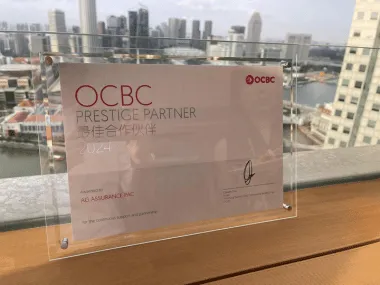

Here’s what our clients have said about us.
Many Singapore companies need internal audit and external (statutory) audit at the same time but for different reasons — one is a governance and risk function, the other is a legal requirement for non-exempt companies. Ackenting Group (AG) provides both as ACRA-registered auditors, with fixed-fee quotes agreed upfront so you know exactly what each engagement costs before work begins.
What Is the Difference Between Internal and External Audit?
External audit (also called statutory audit) is an independent examination of your company’s financial statements, performed by a public accountant registered with ACRA, resulting in an audit opinion on whether the statements give a true and fair view. It is required annually under the Companies Act unless your company qualifies for audit exemption.
Internal audit is an ongoing, in-house or outsourced function that reviews your company’s risk management, internal controls, and governance processes. It reports to management or the Audit Committee, not to shareholders, and its scope is set by the business rather than by statute for most private companies. The two functions can work together: external auditors may rely on and coordinate with internal audit’s work under auditing standard ISA 610, provided internal audit’s objectivity and competence meet the required threshold — reducing duplicated testing where the scope overlaps.
Is Internal Audit Required in Singapore?
For most private companies, internal audit is not a statutory requirement — it’s adopted voluntarily for stronger risk oversight. It becomes a formal expectation in a few situations:
- SGX-listed companies: the Code of Corporate Governance requires the Board to establish an internal audit function (in-house, outsourced, or co-sourced), with the Audit Committee reviewing its adequacy, effectiveness, independence, and resourcing.
- Investor, lender, or board mandates: some investment agreements or group governance policies require an internal audit function regardless of listing status.
- Grant, licensing, or scheme conditions: certain funding or regulatory schemes may expect documented internal controls review as a condition of participation.
Is External (Statutory) Audit Required in Singapore?
External audit is required under Section 205 of the Companies Act unless your company qualifies for the small company or small group audit exemption — broadly, meeting at least two of three thresholds (revenue ≤ S$10 million, total assets ≤ S$10 million, ≤ 50 employees) for two consecutive financial years. For groups, this test is applied on a consolidated basis as part of a group audit, so one larger subsidiary can disqualify an otherwise-small parent from the exemption. Even if your company is exempt, shareholders holding at least 5% of voting rights can require an audit for a specific financial year — if that request is made, the exemption no longer applies and an auditor must be appointed.
Can One Firm Provide Both Internal and External Audit?
Yes, and many SMEs prefer it — a single audit team already familiar with your financial records, systems, and control environment can scope an internal audit review more efficiently than a firm starting from scratch. AG structures internal and external audit as separate engagements with independent scopes and reporting lines, in line with professional independence requirements, while still giving you one point of contact for both.
How Much Do Internal and External Audit Cost?
Fees for both services depend on your company’s size, industry, and the scope agreed — for internal audit, this includes which processes or departments are in scope and how frequently reviews are performed; for external audit, it depends on transaction volume, entity structure, and prior-year audit findings. We quote both after a short scoping call, and the quote is fixed and agreed before fieldwork begins, with no hourly billing. If your company also needs a statutory audit, grant audit, or has subsidiaries requiring a group consolidation audit, we can scope all of it together under our statutory and specialised audit services.
Why Choose AG for Internal & External Audit
- Fixed-fee quotes, agreed upfront. No hourly billing or surprise invoices mid-engagement.
- Independent scoping for each engagement. Internal and external audit are run as separate, clearly-scoped engagements so reliance and independence requirements are respected.
- One team for every audit need. Beyond internal and external audit, our full range of audit services covers statutory, grant, GTO, and group audits, so you’re not coordinating multiple firms across one filing season.
Frequently Asked Questions
What is the difference between internal audit and external audit?
External audit is an independent, statute-driven examination of your financial statements that results in an audit opinion for shareholders. Internal audit is an ongoing review of your risk management and internal controls that reports to management or the Audit Committee, and its scope is set by the business rather than by law for most private companies.
Is internal audit legally required for my company in Singapore?
For most private companies, no. It becomes a formal requirement mainly for SGX-listed companies under the Code of Corporate Governance, or where an investor, lender, or group policy specifically requires it.
Does my company still need an external audit if we’re a small company?
Not necessarily — companies meeting the small company exemption criteria (at least two of: revenue ≤ S$10 million, total assets ≤ S$10 million, ≤ 50 employees, for two consecutive years) are exempt from statutory audit, unless shareholders holding at least 5% of voting rights request one for a specific year.
Can AG provide both our internal audit and our statutory audit?
Yes. We run internal and external audit as separate, independently scoped engagements, so you get one team that already understands your business without compromising audit independence.
How long does an internal audit review take? It depends on how many processes or departments are in scope. We agree the scope and timeline with you upfront during a short scoping call, before quoting a fixed fee.